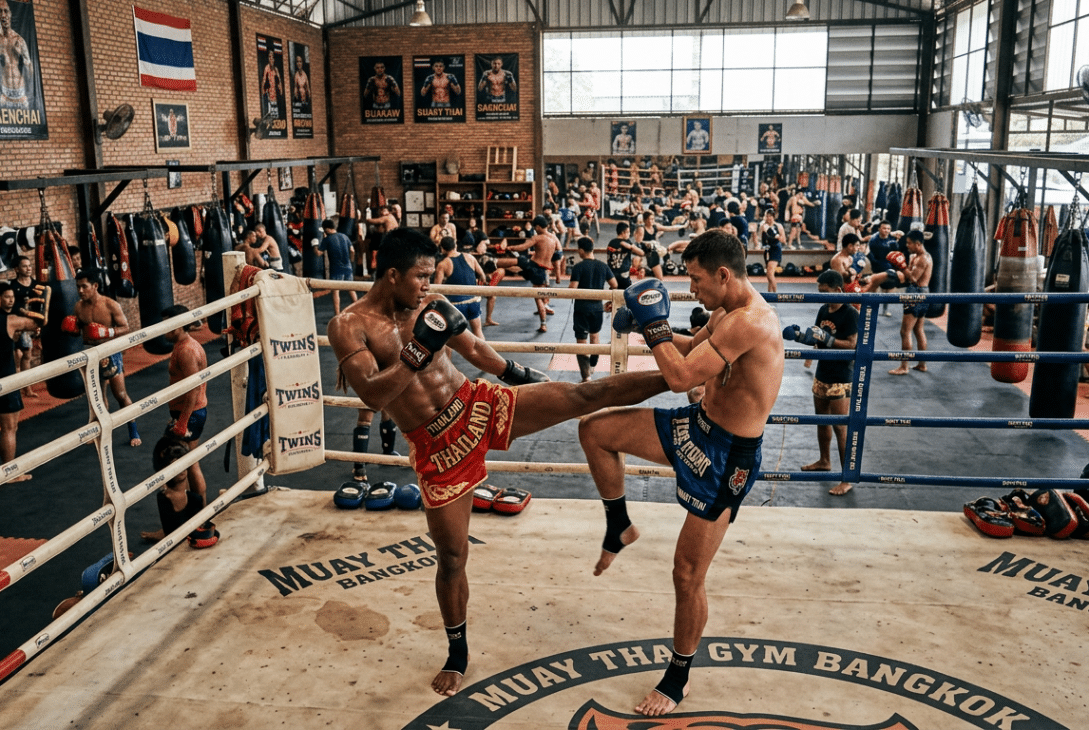
Muay Thai, Thailand’s national sport, has captured the world’s attention with its dynamic style. This ancient fighting art started as a military tactic. Now, it’s a sport loved worldwide, drawing people of all ages and genders. Known as the “art of eight limbs,” it uses the whole body as weapons, including punches, elbows, knees, and kicks.
Its global fame comes from its exciting and varied nature. It offers a full training program that covers physical, mental, and cultural aspects. Muay Thai is perfect for those who want to boost their self-defense skills, stay fit, or enjoy the rush of this sport.
Key Takeaways
- Muay Thai is a martial art that utilizes the entire body as a weapon, including punches, elbows, knees, and kicks.
- Muay Thai has a rich history rooted in Thailand’s military traditions and has evolved into a globally celebrated sport.
- attracts practitioners of all ages and genders, offering a comprehensive training regimen that combines physical, mental, and cultural elements.
- Competitions feature specific gear, weight classes, and scoring systems that add to the sport’s unique identity.
- Muay Thai has become a popular choice for those seeking effective self-defense skills, physical fitness, or the thrill of an intense combat sport.
The Origins and History of Muay Thai
Known as the “Art of Eight Limbs,” it has a long history in Thai martial arts. It goes back hundreds of years3. The Thai military first developed this ancient fighting style for self-defense and warfare. The first time Muay Thai was practiced as a sport was during King Prachao Sua’s reign (1697-1709 A.D.). In 1774, Nai Khanom Dtom made Muay Thai famous by defeating a group of Burmese.
Ancient Roots in Thai Military Tactics
The Thai army has always supported Muay Thai, using it for self-defense since its inception3. Over time, Muay Thai grew to be a key part of Thai culture and heritage3.
Transformation into a Celebrated Sport
As Siam (now Thailand) moved forward, Muay Thai became more popular as a sport and form of entertainment. During the Krungsri Ayutthaya era (1350-1767), Thai fighters and trainers earned high respect. The King Naresuan era (1590-1605) made it crucial in military training, entertainment, and cultural events.
In the early 1930s, they officially established it as a sport with rules and regulations. This change helped Muay Thai grow and get recognized worldwide, becoming a top ring sport3.
“The art has been practiced by hundreds of thousands of people worldwide since its introduction to many countries during the latter half of the 20th century.”
The World Thai Boxing Association (WTBA), started in 1968 by Ajarn Surachai “Chai” Sirisute, has been key in spreading Muay Thai globally. Ajarn Chai’s hard work over 40 years has helped Muay Thai reach the world.
The story of Nai Khanom Tom, a famous fighter in 1774, shows the importance of the art in Thai culture and its spread beyond Thai borders.
What is Muay Thai?
Muay Thai, also known as “The Art of Eight Limbs,” is a powerful martial art loved by many around the world. It uses punches, kicks, elbows, and knees for fighting, making it a full combat skill. This ancient Thai fighting style has grown over many years, blending into Thailand’s deep culture.
The Art of Eight Limbs
The name “The Art of Eight Limbs” comes from using eight parts of the body in fights—fists, elbows, knees, and shins. This method lets fighters strike in many ways, making Muay Thai exciting and demanding.
Punches, Kicks, Elbows, and Knees
Muay Thai is known for its wide range of strikes. Fighters switch between punches, kicks, elbows, and knees easily, making their attacks unpredictable. This skill, along with clinching and sweeping, makes Muay Thai tough and requires skill and flexibility.
Using both upper- and lower-body strikes, the fights are fast and strong, drawing fans and pushing fighters to learn many techniques. Fighters can hit the legs, body, or head using any of the eight contact points to win.
“This is not just a sport; it’s a way of life. The discipline, dedication, and respect ingrained in this art make it a truly transformative experience.”
Muay Thai for Everyone
The “Art of Eight Limbs” is for everyone, not just top fighters or experts. It welcomes people of all ages, genders, and fitness levels. This sport is the top striking art, honed over centuries for combat. It uses knees, elbows, shins, and hands, making it ideal for all fighting ranges. It’s perfect for men, women, and kids at different fitness levels, offering a workout that can burn over 1,000 calories per hour.
At gyms, people train for many reasons, like fitness, weight loss, self-defense, or to fight. Not all trainees aim to fight, but their reasons and dedication matter more than just motivation9. “Heart,” or the will to push through challenges, is crucial for success.
Muay Thai builds physical strength and resilience and helps with personal growth. It boosts confidence, self-defense skills, and discipline through strict training. The sport shows its impact on personal development by helping people at different ages reach their full potential.
Looking for a tough workout, self-defense skills, or personal change? Muay Thai is a proven martial art for self-defense in real life. It’s an aerobic and anaerobic workout that strengthens the mind, body, and spirit, building confidence, discipline, and inner strength.
| Reason for Joining Muay Thai Gym | Percentage of Participants |
|---|---|
| Get Fit | 45% |
| Lose Weight | 30% |
| Learn Self-Defense | 20% |
| Actively Fight/Express Interest in Fighting | 5% |
Traditional Muay Thai Gear and Attire
Muay Thai is more than just a martial art. It’s a sport with deep roots in tradition. The clothes and gear fighters wear are key to this tradition. Each item, like the Mongkhon headband and Pra Jiad armbands, tells a story.
Gloves, Mouthguards, and Shorts
Fighters wear special gear for safety in Muay Thai matches. This includes gloves that weigh 6 to 10 ounces and have a lace-up design for support. They also use mouthguards and shorts that go above the knees for movement. Hand wraps and ankle guards are important too, offering support for the wrists, hands, and ankles.
Cultural Significance of Mongkhon and Pra Jiad
There’s more to Muay Thai gear than just protection. Fighters wear traditional items with deep cultural meaning. The Mongkhon headband is believed to bring luck and protection. The Pra Jiad armbands, made from fabric from a mother’s dress, are thought to bring positive fortune.
These items add beauty to Muay Thai and remind us of its rich history. They show the traditions that shape the sport and its practitioners.
Weight Classes in Muay Thai
Muay Thai, a famous martial art from Thailand, has a detailed system of weight classes. These divisions make sure fights are fair and competitive. Fighters face opponents of similar size and strength. To compete, fighters must be at least 15 years old and weigh over 100 pounds. The weight difference between fighters can’t be more than five pounds.
Muay Thai’s weight classes accommodate athletes of all body types. The WBC Muay Thai has divisions from heavyweight to minimum weight for men and from super lightweight to minimum weight for women. ONE Championship also has divisions from lightweight to atomweight for men and women.
| Promotion | Male Divisions | Female Divisions |
|---|---|---|
| WBC Muay Thai | Heavyweight (91 kg+) to Minimum Weight (47.627 kg) | Super Lightweight (63.5 kg) to Minimum Weight (45.359 kg) |
| ONE Championship | Lightweight (77.1 kg) to Strawweight (56.7 kg) | Strawweight (56.7 kg) to Atomweight (52.2 kg) |
| Rajadamnern Stadium | Middleweight (72.5 kg) to Minimumweight (47.6 kg) | N/A |
| Lumpinee Stadium | Heavyweight (+79.383 kg) to Mini Flyweight (47.629 kg) | N/A |
| World Muay Thai Council | Super Heavyweight (+ 95 kg) to Mini Flyweight (47.62 kg) | N/A |
Muay Thai has its own weight classes, unlike boxing, kickboxing, and MMA. The UFC has divisions from heavyweight to women’s strawweight, while GLORY Kickboxing has divisions from heavyweight to women’s super bantamweight.
The history of Muay Thai weight classes goes back to King Rama VI. Today, fighters use methods like water weight loss and changing their diets to fit their division’s weight.
In conclusion, Muay Thai’s weight class system is key for fair fights. It lets athletes compete against others of similar size and skill.
The Structure of a Muay Thai Match
Muay Thai matches are structured events with clear rules agreed upon by fighters and their coaches. They take place in a ring, with ropes marking the fighting area. The fighters, their coaches, and a referee are in the ring. Three judges score the match from ringside.
Rounds, Rules, and Scoring
A Muay Thai match has set rounds, each lasting a certain time. In Lumpinee and Rajadamnern stadiums, fights last 5 rounds of 3 minutes each. Points are given for strikes landed, and the winner is decided at the end or by knockout.
Scoring is simple: the winner of each round gets 10 points, the loser 9, 8, or 7. A fighter can score up to 50 points in a match. Legal moves include punches, elbows, knees, kicks, sweeps, and throws. But headbutts, biting, eye poking, and hitting the genitals are fouls.
Muay Thai is a dynamic martial art with various styles. “Muay Mat” fighters are known for their strong punches and kicks. “Muay Tae” practitioners are skilled in powerful kicks and movement. “Muay Sok” focuses on elbows, and “Muay Khao” on knee strikes and pressure. “Muay Femur” and “Muay Bouk” also have their unique styles, showing Muay Thai’s diversity.

Transitioning from Muay Thai to other sports like kickboxing and boxing is interesting. Fighters like Samart Payakaroon and Valentina Shevchenko have made successful moves. But moving from these sports to Muay Thai is harder, showing its unique demands.
Muay Thai has a long history, starting as a military tactic in the late 16th century. The name “Thai” was added to distinguish it from Western boxing, highlighting its unique moves.
Muay Thai Scoring and Judging
The Muay Thai scoring system focuses on effective strikes. It values clean, powerful strikes with all weapons. Judges care more about the quality of strikes than the number thrown. Judges look for who was closest to ending the fight with a knockout.
Unlike other combat sports, scoring is different from the 10-point must system. Judges look at the fight as a whole, not just each round, when scoring. A fighter can win by dominating the final round, even if they were behind early.
Scoring in Muay Thai focuses on clean kicks, knees, punches, and elbows to the body. Judges look for heavy, powerful attacks to decide the round winner. Causing an opponent to lose balance with a kick or throw and then striking with significant force is a good way to score.
Fights in Muay Thai use a 10-point must system, where the winner receives 10 points and the loser gets fewer points. Judges look at the fight overall, not just each round, to pick a winner.
| Scoring Criteria in Muay Thai | Explanation |
|---|---|
| Effective Strikes | Clean, powerful strikes using all weapons are crucial. Emphasis is on quality over quantity. |
| Aggression | Pushing the pace and forcing the action can earn points, but it’s not as valued as effective striking. |
| Ring Control & Dominance | The ability to control the opponent and set the tempo is crucial in Muay Thai judging. |
| Closest to a KO | Judges heavily weigh who was closest to finishing the fight by knockout. |
In summary, the Muay Thai scoring system values effective striking, aggression, and controlling the ring. The goal is to find out who was closest to ending the fight with a knockout.
The Wai Kru Ram Muay Ritual
As Muay Thai athletes enter the ring, they perform a special ritual called the Wai Kru Ram Muay. This dance has two parts: the Wai Kru and the Ram Muay. They wear their Mongkhons, traditional headbands, to show respect to their coaches, teammates, family, and gym.
The Wai Kru part has the fighter circle the ring and stop at each corner to pray. Circling the ring is key to the Wai Kru ceremony. The Wai Kru includes a kneel, a bow, and the “Wai” gesture, done three times.
Then, the fighter does the Ram Muay, a dance to traditional Thai music. This dance can last a few minutes and includes moves inspired by the mythical Hanuman. The dance shows the fighter’s training and where they come from.
The Wai Kru Ram Muay is a key tradition in Muay Thai that shows respect and gratitude. It has become a timeless tradition that still moves and honors Muay Thai today.
“The Wai Kru ceremony is integral in Muay Thai competitions, showing respect and gratitude to teachers, parents, and ancestors.”
The Wai Kru Ram Muay is set to Sarama, traditional Thai music, adding to the ceremony’s feel. Every year, thousands of fighters come to Ayutthaya, Thailand, for the World Wai Kru Ceremony.
Conclusion
Muay Thai is the national sport and cultural martial art of Thailand, with a history that goes back centuries. It started as a way to fight in the military and has become a sport loved by people everywhere. Muay Thai stands out because of its unique moves like punches, kicks, elbows, and knees. These moves make it a full workout and exciting to watch.
Anyone can try, no matter their age or skill level. There are gyms and camps for those wanting to learn self-defense, get fit, or compete. The sport also has deep traditions, like the Wai Kru Ram Muay ritual, which adds to its charm and importance. Muay Thai is becoming more popular worldwide, with training places opening outside Thailand. Top MMA fighters are now using its effective moves in their training.
People are drawn to its rich martial arts history, the challenge it offers, and its vibrant culture. As Muay Thai grows and gains worldwide recognition, it has a bright future ahead.
FAQ
What is Muay Thai?
Muay Thai is a martial art from Thailand, also known as “The Art of Eight Limbs.” It uses punches, kicks, elbows, and knees. This makes it a powerful and effective combat sport.
What are the origins of Muay Thai?
Thai boxing started in Thai military history as a combat technique. Over time, it became a sport under Thai royalty. Now, it’s Thailand’s national sport.
What are the unique techniques?
Known as the “Art of Eight Limbs,” the art uses punches, kicks, elbows, and knees. This gives fighters a versatile and strong way to strike.
Who can practice Muay Thai?
Anyone can learn Muay Thai, from beginners to those looking for self-defense skills. Gyms offer classes for kids, families, and new students.
What kind of gear and attire do Thai boxers and practitioners wear?
Fighters wear protective gear like gloves and mouthguards. They also use Muay Thai shorts. Traditional items like the Mongkhon headband and Pra Jiad armbands are worn too.
How are Muay Thai matches organized?
Matches are in weight classes, with fighters meeting certain weight requirements. The fight takes place in a ring with a referee and judges. Winners are chosen based on strikes and performance.
How is scoring done in matches?
Judges score based on strikes landed and their impact. Fighters earn points for effective strikes that make their opponent stumble. The winner is the fighter with the most points or a knockout.
What is the Wai Kru Ram Muay ritual in Muay Thai?
The Wai Kru Ram Muay is a pre-fight ritual. Fighters show respect to their coaches and team with a dance in the ring. It’s a key part of Muay Thai culture.
Source Links
- Why is it Called the “Art of 8 Limbs”? – https://integratedcombatcentre.com.au/why-is-muay-thai-called-the-art-of-8-limbs/
Combat sports Eight limbs fighting style Martial arts training Muay Thai techniques Traditional Thai fighting
Last modified: